
Why This Article Exists
Most Indian families don’t mind paying more — they mind paying blindly.
This guide is written to:
-
explain where the money actually goes in authentic A2 bilona ghee
-
separate tradition from marketing hype
-
help families decide without pressure or exaggeration
No miracle claims. No fear tactics. Just clarity.
Who This Guide Is For
This article is for you if:
-
You’re buying A2 ghee for the first time
-
You’ve seen wildly different prices online
-
You want quality, but not at any cost
-
You’re responsible for food decisions for your family
The Honest Truth: “A2 Ghee” Is Not a Standardised Product
Unlike packaged oils, the term A2 ghee is not tightly regulated.
This means:
-
The label alone doesn’t guarantee quality
-
Price differences reflect how it’s made, not just branding
-
Two jars can look identical and still be fundamentally different
Understanding this prevents overpaying — or underbuying.
Where the Real Cost Comes From

Indigenous Cow Milk Is Limited
Native Indian cow breeds produce less milk than hybrids.
This is a biological reality, not inefficiency.
Less milk → higher raw material cost → higher ghee cost.
Ghee Is Concentrated Nutrition
Authentic bilona ghee requires 25–30 litres of milk per litre of ghee.
That’s before:
-
fermentation
-
churning
-
slow heating
-
filtration
-
storage losses
When you understand this, the price stops looking arbitrary.
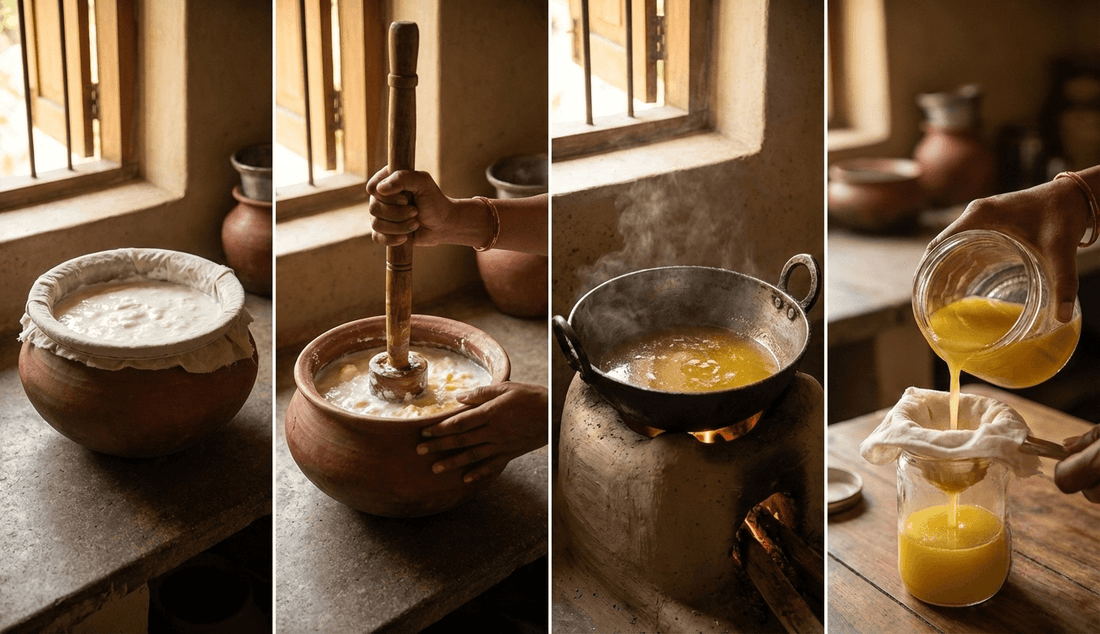
Traditional Processing Is Slow by Design
Bilona ghee:
-
is made from curd, not cream
-
requires human attention, not automation
-
cannot be rushed without compromising quality
Time and labour are part of the value — not inefficiency.
Why Some “A2 Ghee” Is Much Cheaper
Lower-priced products usually reduce cost by:
-
mixing milk sources
-
using cream separators
-
high-heat processing
-
adding aroma for consistency
-
skipping detailed purity testing
This doesn’t always mean the product is unsafe —
but it does mean it’s not equivalent.
Comparison 3: Price vs Long-Term Value
| Factor | Lower-Priced Ghee | Premium A2 Bilona Ghee |
|---|---|---|
| Initial cost | Lower | Higher |
| Usage per meal | More | Less |
| Taste satisfaction | Variable | Higher |
| Digestive comfort | Mixed | Often better |
| Trust factor | Lower | Higher |
Value vs Price: The Right Way to Think About It
Instead of asking “Why is it expensive?”, ask:
-
How much am I actually consuming daily?
-
Is this replacing refined oil or vanaspati?
-
Does it improve taste so I use less?
-
Do I trust what’s inside the jar?
For most families, ghee is used in teaspoons, not bowls.
| Factor | Lower-Priced Ghee | Premium A2 Bilona Ghee |
|---|---|---|
| Initial cost | Lower | Higher |
| Usage per meal | More | Less |
| Taste satisfaction | Variable | Higher |
| Digestive comfort | Mixed | Often better |
| Trust factor | Lower | Higher |
Who Premium A2 Ghee Makes Sense For
It’s a good fit if:
-
you cook daily
-
you value ingredient transparency
-
digestion matters
-
you prefer traditional foods
It may not be necessary if:
-
you rarely use ghee
-
price is your only filter
-
you rotate many cooking fats
Both choices are valid.
| Buyer Checkpoint | Why It Matters |
|---|---|
| Cow breed mentioned | Ensures milk authenticity |
| Bilona process explained | Indicates traditional method |
| Milk-to-ghee ratio | Reflects concentration |
| Lab testing disclosed | Protects against adulteration |
| Batch transparency | Signals accountability |
A Low-Risk Way to Decide for Yourself
The smartest way to judge value is not debate — it’s experience.
Starting with a 500 ml pack:
-
lowers financial risk
-
lets you assess taste and digestion
-
helps you decide calmly
🎉 First-time buyers can use NEW20 for 20% off.


