
Introduction
One of the most common questions consumers ask when buying A2 ghee is:
“How much milk is actually required to make one litre of ghee?”
The answer reveals more than just numbers—it explains why traditionally prepared A2 ghee is valued, how production methods differ, and why transparency matters when choosing ghee for everyday use.
For a complete overview of traditional ghee preparation, you may first want to read:
👉 What Is A2 Bilona Ghee? Process, Benefits & Authenticity Explained
The Short Answer
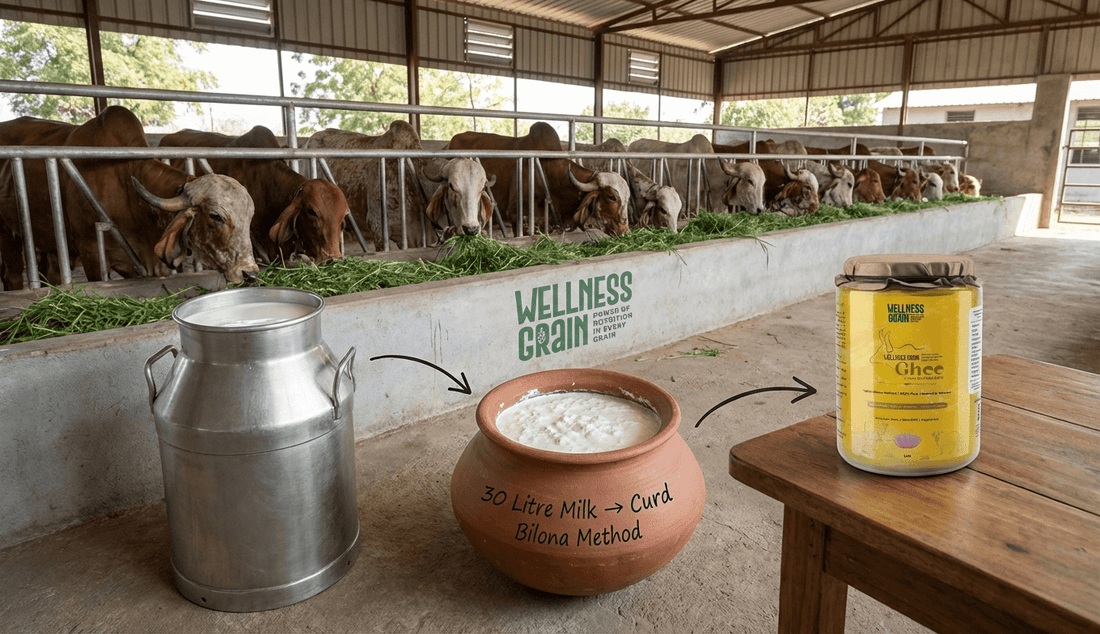
To produce one litre of authentic A2 bilona ghee, it typically takes around 25 to 30 litres of A2 milk.
The exact quantity can vary depending on:
-
Cow breed
-
Milk fat content
-
Season and cow diet
-
Traditional processing efficiency
This high milk requirement is one of the main reasons bilona ghee is produced in small batches rather than at industrial scale.
Why So Much Milk Is Required
The traditional bilona method is curd-based, not cream-based.
Here’s how the process works:
-
Fresh A2 milk is boiled and cooled
-
The milk is fermented into curd
-
The curd is hand-churned to extract butter
-
The butter is slow-cooked to make ghee
At each step, quantity reduces—but quality and concentration increase.
This is very different from industrial methods that extract cream directly and skip fermentation.
Role of Cow Breed and Diet
Indigenous cows such as Gir cows generally produce milk with:
-
Lower volume compared to crossbred cows
-
Naturally richer fat composition
Additionally, grass-fed cows often yield milk with seasonal variation in fat content, which affects how much milk is required per litre of ghee.
This is why traditionally produced ghee cannot be standardized the way industrial ghee is.
Bilona Method vs Industrial Ghee Production
| Aspect | Traditional Bilona Ghee | Industrial Ghee |
|---|---|---|
| Starting material | Curd | Cream |
| Milk required | ~25–30 litres | Significantly less |
| Processing speed | Slow | Fast |
| Batch size | Small | Large |
| Focus | Method & tradition | Volume & efficiency |
Understanding this difference helps explain price variation and production scale.
Why This Matters to Consumers
Knowing how much milk goes into making ghee helps consumers:
-
Understand production transparency
-
Recognize why bilona ghee is not mass-produced
-
Make informed comparisons between products
Brands that clearly explain their process—such as
👉 A2 Gir Cow Bilona Ghee
allow buyers to evaluate value beyond labels alone.
Does More Milk Always Mean Better Ghee?
Not necessarily.
While milk quantity is important, quality also depends on:
-
Fermentation method
-
Cooking temperature
-
Handling and storage
-
Hygiene and consistency
Milk volume should be viewed as one indicator, not the only benchmark.
Conclusion
Producing one litre of authentic A2 bilona ghee requires patience, time, and a significant amount of milk—often up to 30 litres. This reflects a process focused on tradition and careful preparation rather than speed or volume.
Understanding this helps consumers make informed choices and appreciate why traditionally prepared ghee remains a valued kitchen staple.


