
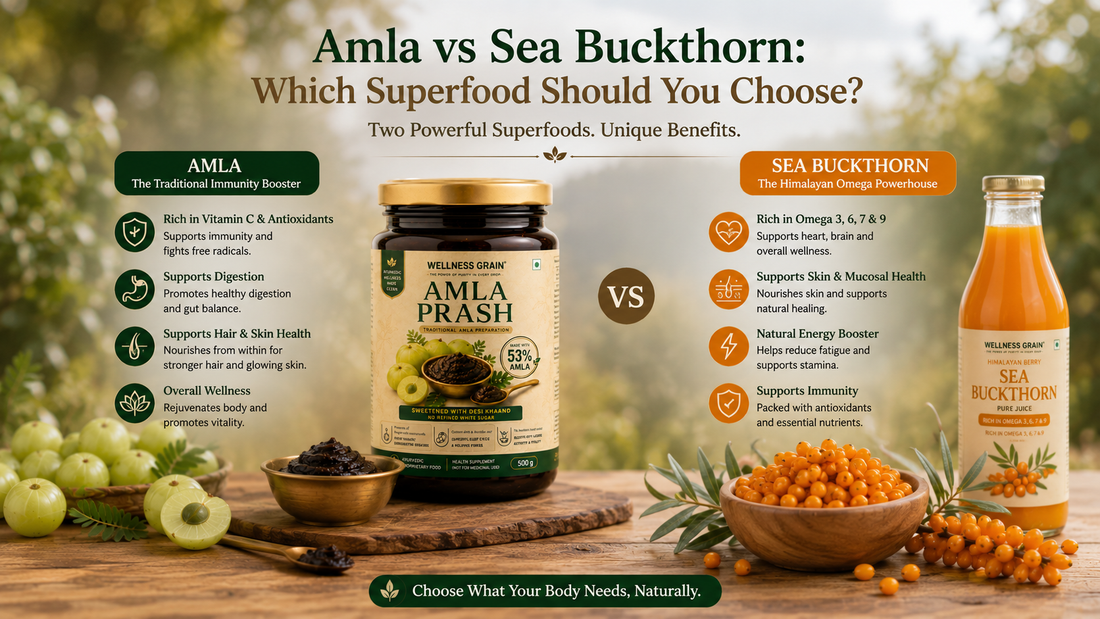
If you're comparing India's two most talked-about superfood berries, amla and sea buckthorn take genuinely different approaches to wellness, rooted in different regions and traditions.
Tradition and origin
Amla has thousands of years of history in mainstream Ayurveda and Indian food culture, grown widely across the country. Sea buckthorn is a more recently popularised ingredient outside its native Himalayan range, traditionally used by high-altitude communities like those in Ladakh.
How they're prepared
Amla is most often turned into preparations like Amla Prash, murabba, and pickles, using sweeteners like desi khaand or jaggery to balance its sharp sourness. Sea buckthorn is more commonly consumed as a diluted juice, given its liquid, oil-rich pulp.
Nutrient focus
- Amla: exceptionally high Vitamin C, polyphenolic compounds, long Ayurvedic tradition of dosha-balancing use
- Sea buckthorn: high Vitamin C alongside a distinctive Omega 3, 6, 7 and 9 fatty acid blend, and carotenoids
Which fits your routine better?
If you want a traditional Ayurvedic daily food with a long history and simple use, Amla Prash is a natural fit. If you're drawn to a Himalayan-origin juice with a unique fatty acid profile, sea buckthorn juice is worth trying. Many people use both, since they serve different roles in a routine rather than competing directly.
Related reading
- What is Amla Prash? A complete guide
- Sea buckthorn juice: the complete guide
- Sea buckthorn vs amla: comparing two superfoods
Explore Wellness Grain's full range
This article is for general wellness information and isn't a substitute for medical advice.


