
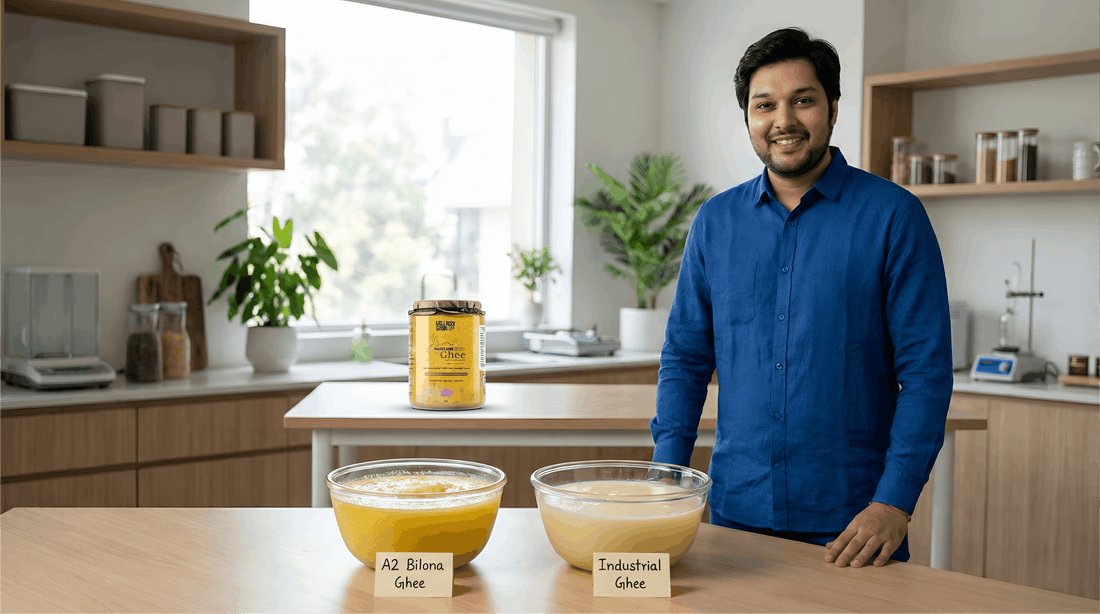
Introduction
Ghee has been part of Indian cooking for generations, but as demand has increased, so have variations in how ghee is produced. Today, shoppers often encounter labels such as A2 ghee, desi ghee, and regular ghee—yet the differences between them are rarely explained clearly.
Understanding the distinction between A2 ghee and regular ghee is important, especially for families who use ghee daily. This article breaks down the differences based on milk source, preparation method, and everyday use, without marketing hype or exaggerated claims.
For a complete foundation on traditional preparation, you may also want to read our detailed guide on
👉 What Is A2 Bilona Ghee? Process, Benefits & Authenticity Explained
What Is Regular Ghee?
Regular ghee available in the market is often produced at scale using modern dairy processes. In most cases:
-
Milk is sourced from mixed or crossbred cows
-
Cream is mechanically separated from milk
-
The cream is heated rapidly to extract ghee
This method is efficient and cost-effective, making regular ghee widely available. However, the focus is typically on volume and consistency, not on traditional preparation.
What Is A2 Ghee?
A2 ghee is made from milk that naturally contains A2 beta-casein protein, commonly found in indigenous Indian cow breeds such as Gir cows.
When A2 milk is processed using traditional methods—particularly the bilona (curd-churning) process—the resulting ghee differs in both preparation and character from mass-produced ghee.
To understand this process step by step, refer to our master guide on
👉 A2 Bilona Ghee and its traditional method
Key Differences Between A2 Ghee and Regular Ghee
| Aspect | A2 Ghee | Regular Ghee |
|---|---|---|
| Milk source | Indigenous A2 cows (e.g., Gir) | Often crossbred or mixed |
| Protein type | A2 beta-casein | A1 or mixed |
| Preparation | Traditionally curd-churned (bilona) | Cream separation |
| Cooking process | Slow, low-heat | High-temperature |
| Aroma & texture | Rich, nutty, often grainy | Mild or neutral |
| Usage | Traditional daily cooking | Mass consumption |
These differences stem largely from how the ghee is made, rather than just what it is called.
Does the Preparation Method Matter?
Yes—preparation plays a major role.
Traditional bilona ghee is made by fermenting milk into curd first, then churning it to extract butter. This process has been followed in Indian households for centuries and is deeply tied to traditional diets.
Regular ghee, on the other hand, skips fermentation entirely, focusing instead on speed and scalability.
Which One Is Better for Daily Indian Cooking?
The answer depends on individual preference and usage. Many families who follow traditional diets prefer A2 ghee because:
-
It aligns with ancestral cooking practices
-
It offers a distinct aroma and mouthfeel
-
It is commonly used in moderation for daily meals
For households seeking ghee prepared using traditional methods, products like
👉 A2 Gir Cow Bilona Ghee
are often chosen for regular use.


