
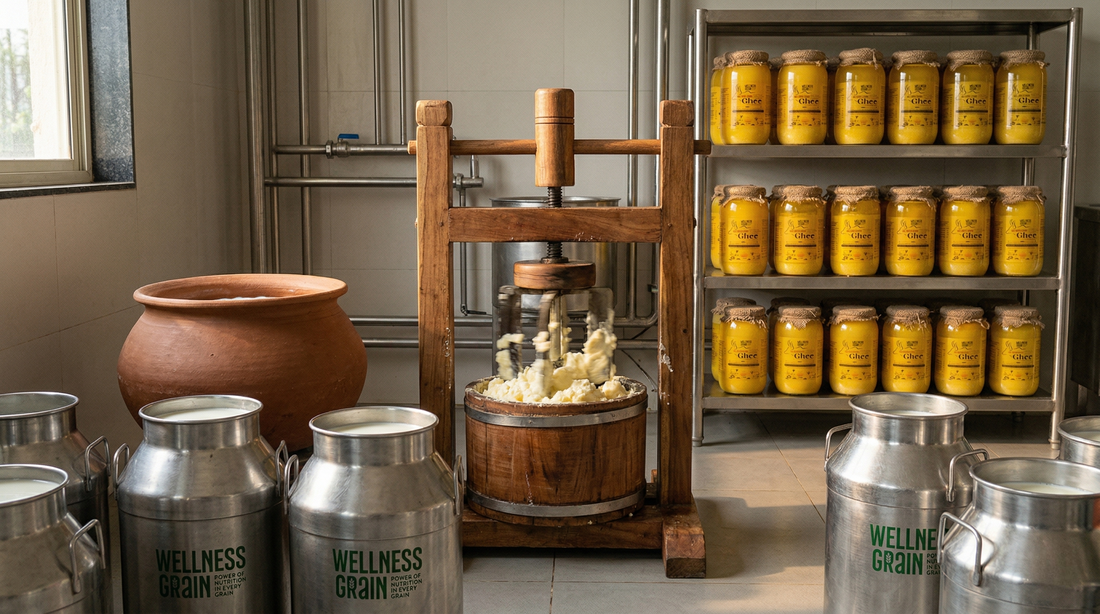
It is a fair question, and one worth answering with actual numbers instead of a vague "quality costs more" line: why does a jar of A2 Bilona ghee cost several times what a supermarket ghee tin costs?
1. The milk-to-ghee ratio
Making one litre of ghee the traditional way requires a large quantity of milk, since milk has to first become curd, then butter, then ghee, losing volume at each stage. A high-volume commercial process optimised purely for output does not necessarily follow the same ratio.
2. Indigenous breed milk yields less, per cow, than crossbreeds
Gir cows generally produce less milk per day than high-yield crossbred or European dairy breeds bred specifically to maximise output. Lower yield per animal, spread across the same fixed farming costs, means a higher cost per litre of milk from the start.
3. The bilona method is slow, deliberately
Hand-churning curd into butter, then slow-cooking that butter into ghee over a controlled flame, takes meaningfully longer than industrial cream separation and continuous processing. Labour-intensive, low-throughput production costs more per unit than an automated high-volume line.
4. Small-batch farming vs industrial dairy economics
Large dairies benefit from economies of scale: bulk feed purchasing, automated milking, high-volume processing. Small farms raising indigenous cows the traditional way do not get those same economies, and that cost gets passed through the supply chain.
5. Testing and quality control
Lab-tested batches, checked for purity and adulteration, add a real cost step that budget ghee brands often skip entirely.
What you are actually paying for
- A lower milk-to-ghee yield done properly, not cut short
- Lower-yield indigenous cow breeds instead of high-output crossbreeds
- A slower, hand-churned production method
- Small-batch farming without industrial economies of scale
- Lab testing most budget brands skip


