
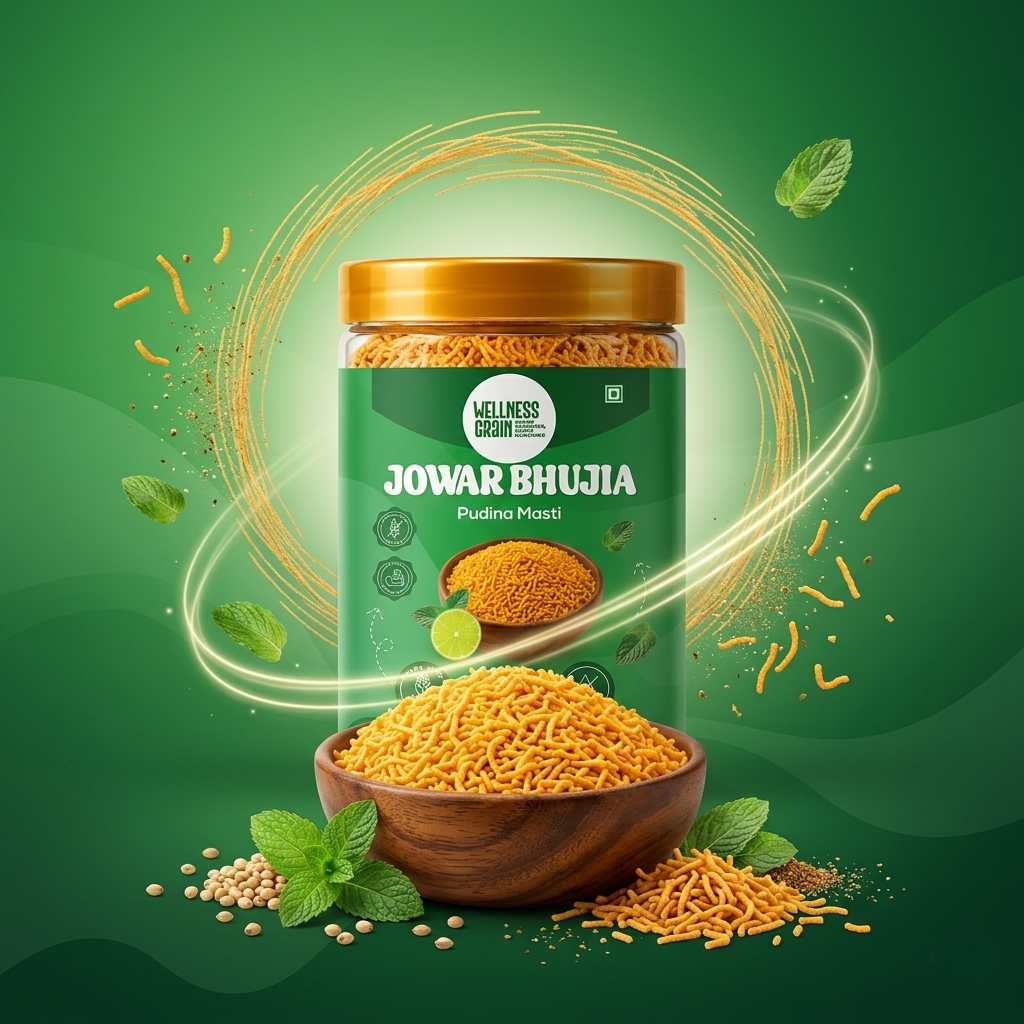
Bhujia is not really a snack in India. It is an event. It is what appears the second unannounced guests walk in, what your dadi keeps in a steel dabba that never seems to empty, what shows up at every train station stall between here and everywhere. It is also, in its classic form, deep fried in a way that has never once been marketed as good for you, and nobody ever asked it to be.
So why mess with it
Because bhujia is too good a snack to only exist in one version. Jowar Bhujia keeps everything that made the original one an institution, the crunch, the sev-like texture, the punch of spice, and rebuilds it on a jowar (sorghum) base with real mint and amchur, baked instead of fried.
What is different underneath
- The grain: jowar flour instead of refined besan and maida blends
- The process: baked, not deep-fried, so no repeated hot-oil frying involved
- The flavour: real mint and amchur (dried mango powder) rather than artificial flavouring, plus Himalayan spices
- The oil: no palm oil in the mix
The nostalgia test
The real test for any bhujia is simple: does it still feel like the one you grew up eating? That was the bar here, not "a healthier snack that happens to be sev-shaped," but an actual bhujia that happens to be built better.
Where jowar comes from
Curious about sorghum itself and why it has quietly powered Indian food for generations? Read Jowar 101.


