
Introduction
One of the most surprising facts about ghee is this:
👉 It takes approximately 25 to 30 litres of milk to produce just 1 litre of pure ghee.
For many consumers, this raises an important question:
Why does ghee require so much milk, and what does that say about its quality and price?
Understanding this process helps explain:
- Why authentic ghee is expensive
- Why cheap ghee should be questioned
- What “pure ghee” really means
This article breaks it down in a simple, practical way.
How Milk Turns Into Ghee: Step-by-Step
To understand the quantity required, you need to understand the process.
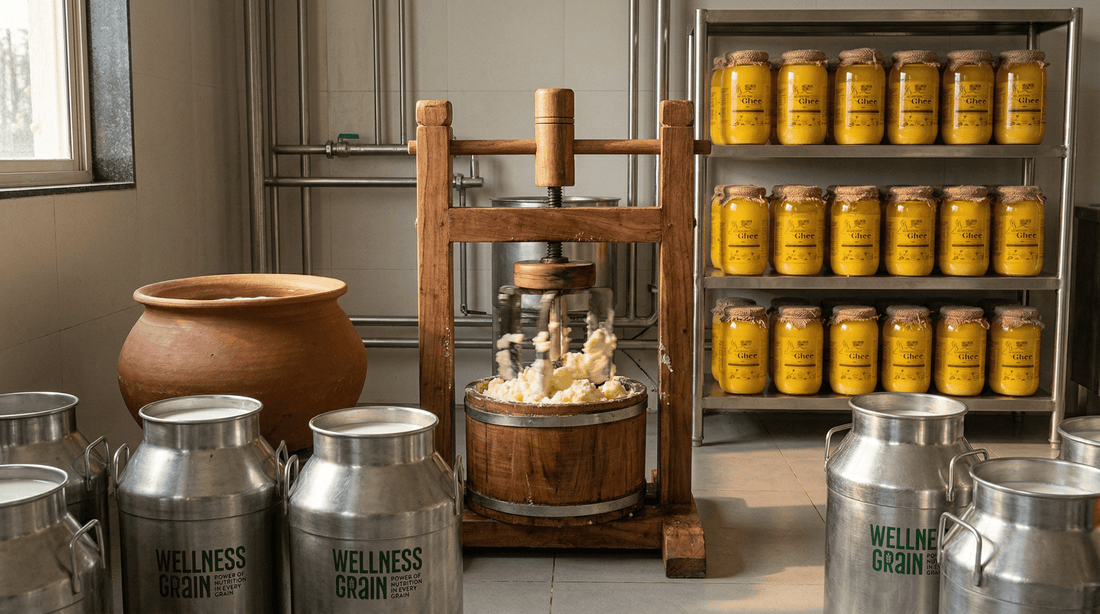
Traditional ghee (especially bilona ghee) follows this journey:
Milk → Curd → Butter → Ghee
At each stage, volume reduces significantly.
Step 1: Milk Composition
Milk is mostly water.
On average, cow milk contains:
- 85–88% water
- 3–5% fat
- Remaining proteins, lactose, and minerals
Only the fat portion is eventually converted into ghee.
This means the majority of milk does not become ghee.
Step 2: Milk to Curd
Milk is first converted into curd (dahi).
During this stage:
- Fermentation occurs
- Water content remains high
- Fat is still dispersed
This step is essential in traditional bilona ghee production.
Step 3: Curd to Butter
The curd is churned to extract butter (makkhan).
Here:
- Fat separates from liquid (buttermilk)
- Large volume is lost
- Only a small portion becomes butter
This is one of the biggest reduction points.
Step 4: Butter to Ghee
Butter is then slow-heated to produce ghee.
During this process:
- Remaining water evaporates
- Milk solids separate
- Only pure fat remains
At this stage, final yield becomes extremely low.
Final Output
👉 From 25–30 litres of milk → ~1 litre of ghee
This is why ghee is considered a concentrated form of milk nutrition.
Why Bilona Ghee Requires Even More Milk
Traditional bilona ghee often requires more milk than industrial ghee because:
- Fermentation reduces usable fat
- Manual churning is less efficient than machines
- Small-batch production reduces yield
- Slow heating causes natural evaporation
However, this method improves:
- Aroma
- Texture
- Digestibility
- Authenticity
👉 Related reading: Bilona Ghee vs Cream-Based Ghee: Why the Method Matters More Than You Think
Why Cheap Ghee Exists in the Market
If ghee requires so much milk, then how do some brands sell it cheaply?
Possible reasons include:
- Mixing with vegetable oils
- Using low-fat or diluted milk
- Skipping fermentation
- High-speed industrial production
- Blending different fat sources
In extreme cases, adulteration may occur.
👉 Related reading: Ghee Adulteration in India: What Happened in Gujarat & How to Protect Yourself
What This Means for Pricing
The price of ghee is directly influenced by:
- Milk quantity required
- Cost of sourcing quality milk
- Time required for processing
- Method used (bilona vs industrial)
- Scale of production
This is why authentic A2 bilona ghee is typically priced higher than mass-produced alternatives.
👉 Related reading: Is A2 Ghee Worth the Price? A Transparent Cost & Value Guide
Why More Milk Often Means Better Quality
Higher milk input usually indicates:
- Less dilution
- Higher purity
- Better fat concentration
- Authentic production
Because ghee is derived only from milk fat, using more milk generally results in a richer, more natural product.
Does More Milk Always Mean Better Ghee?
Not necessarily.
Quality also depends on:
- Breed of cow (e.g., Gir cows)
- Feed and grazing conditions
- Processing method
- Storage and handling
👉 Related reading: Why Gir Cows Are Trusted for Ghee in Indian Tradition
The Hidden Cost Behind Every Spoon of Ghee
When you add a spoon of ghee to your meal, you are not just adding fat.
You are consuming:
- The nutrition of multiple litres of milk
- Time taken for fermentation
- Effort of churning
- Careful heating process
This is why traditionally made ghee has always been valued in Indian households.
Why Consumers Should Understand This
Knowing how ghee is made helps consumers:
- Avoid misleading low-price products
- Appreciate traditional methods
- Make informed buying decisions
- Understand value beyond packaging
It shifts the focus from price to process.
Final Thoughts
Ghee is not just another cooking fat. It is a concentrated product that requires a large quantity of milk, time, and careful processing.
The next time you see a jar of ghee, remember:
👉 Its value is not just in the label — it is in the journey from milk to ghee.
Understanding this helps you choose better, consume wisely, and appreciate the role of ghee in traditional Indian diets.
Shop Pure A2 Ghee - A2 Gir Cow Bilona Ghee | Pure Desi Ghee for Digestion & Immunity – Wellness Grain


