
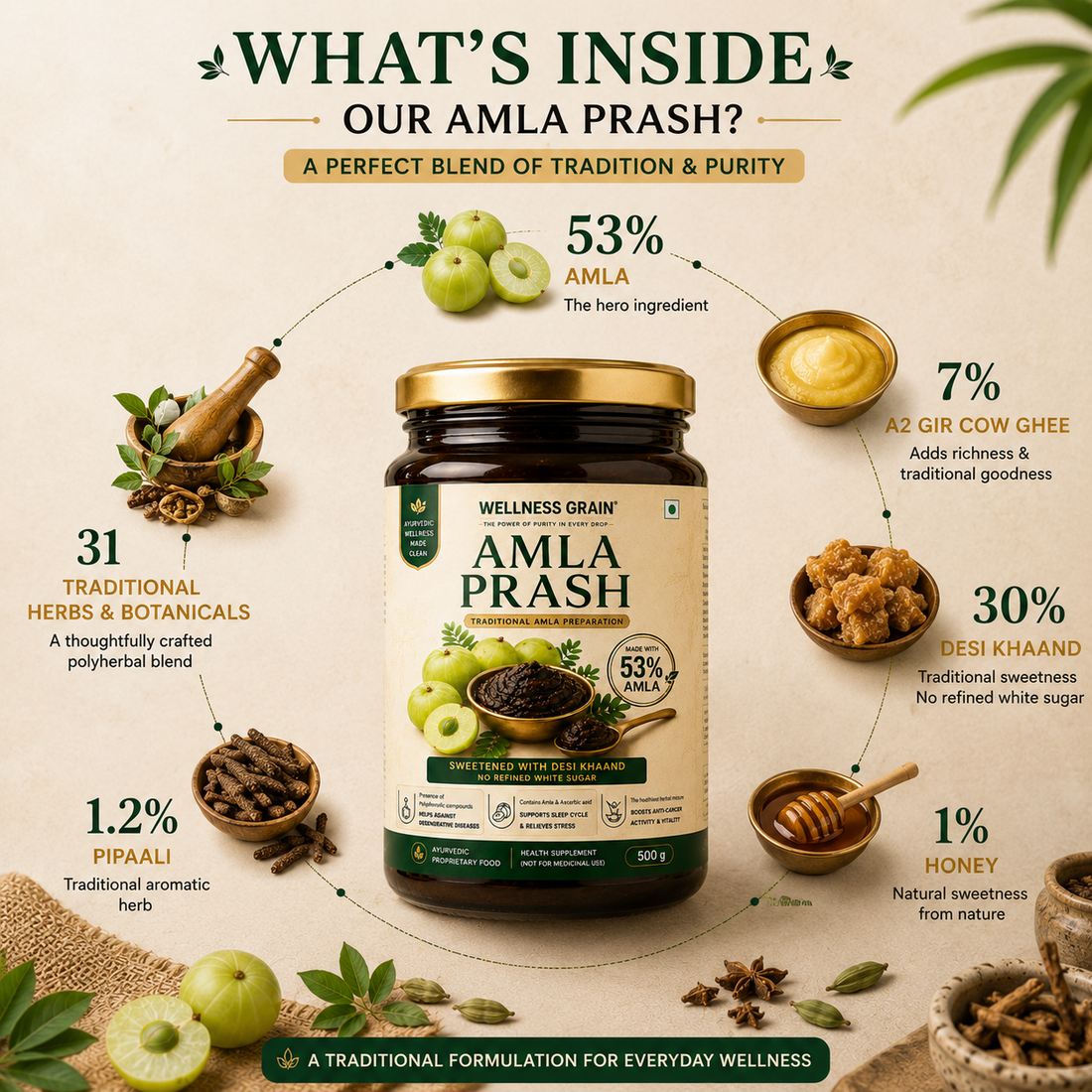
Read the front of most jars and you will see one big number and maybe one hero ingredient. Wellness Grain Amla Prash has a longer cast: 53% amla, 7% A2 Gir cow ghee, desi khaand, honey, and 31 traditional herbs and botanicals. Here is who is in the jar, grouped by what they bring to the table.
The star: amla
At 53%, amla (Indian gooseberry) is more than half the preparation. It is tangy, astringent and the reason the whole thing tastes the way it does.
The rich base: A2 Gir cow ghee
Ghee makes up 7% and gives the prash its smooth, spoonable texture. We tell that story in why there is ghee in Amla Prash.
The sweeteners: desi khaand and honey
Amla is sharp on its own, so it is balanced with desi khaand, a minimally processed sugar, and honey. Together they round off the tang without refined white sugar.
The botanicals
The label names Pippali, Tejpatta, Dalchini, Nagkesar, Bel, Punarnawa, Kachur, Elaichi, Gambhari, Pushkarmool, Gokhru, Shatavari, Safed Chandan, Kakoli and Anant Mool, among others. Think of them in families:
- Warming kitchen spices: Dalchini (cinnamon), Elaichi (cardamom), Tejpatta (bay leaf), Pippali (long pepper). Meet them in cinnamon, cardamom and bay leaf and the Pippali story.
- Roots and barks from Ayurvedic formulations: Shatavari, Gokhru, Punarnawa, Pushkarmool, Anant Mool, Kachur. Read more in Shatavari, Gokhru and Punarnava.
- Fragrant and cooling ingredients: Safed Chandan (white sandalwood), Nagkesar, Bel.
- Traditional lesser-known herbs: Gambhari and Kakoli, which appear in classical Ayurvedic recipes but rarely in modern pantries.
Why list them at all?
Transparency. A long ingredient list is only useful if you can see what is on it, so we name the herbs instead of hiding behind a generic herbal blend. For how to judge any brand's list, use our buyer's checklist.
Keep reading
Shop Wellness Grain Amla Prash
This article is for general wellness information and isn't a substitute for medical advice. Botanicals are described by traditional use, not as treatments for any condition.


