
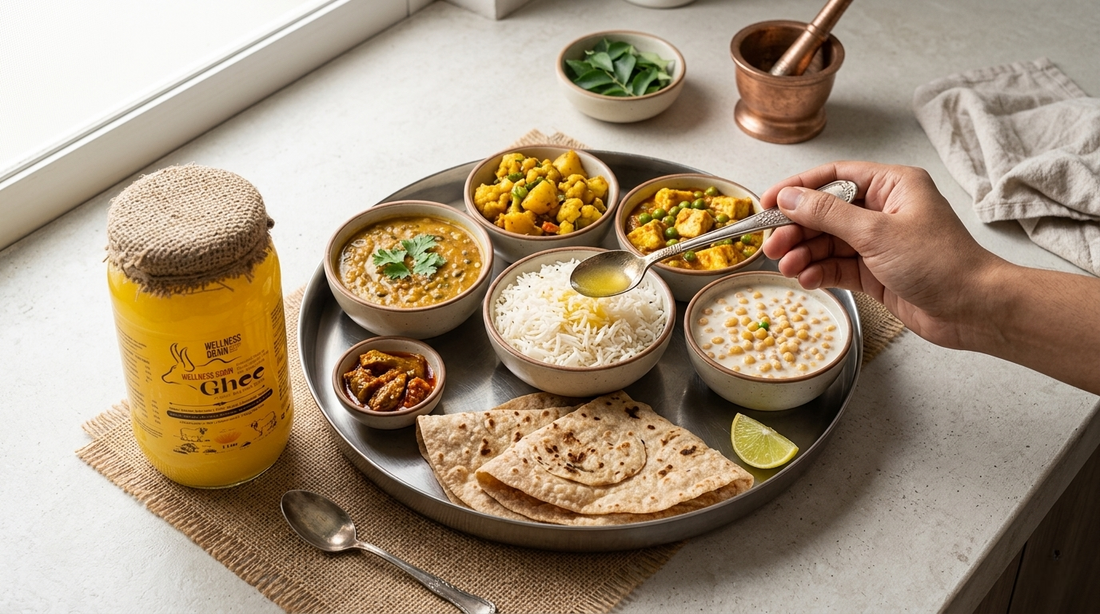
Travel across India and the ghee on the plate keeps changing character, even though the jar it came from looks the same everywhere. Same fat, completely different roles depending on which kitchen it walks into.
Karnataka and Andhra: ghee rice
Ghee rice (or ghee bhaat) is a fragrant, mildly spiced rice dish where ghee is not a garnish, it is a main ingredient, cooked into the rice alongside whole spices and sometimes cashews. The dish would not have a name without it.
Karnataka's other icon: ghee roast
Mangalorean ghee roast, most famously with chicken or mushroom, uses a fiery, tangy masala finished and cooked through with a generous hand of ghee, which mellows the heat just enough to keep it edible while keeping every bit of the flavour.
North India: ghee halwa
Sooji halwa, gajar halwa, moong dal halwa, the entire halwa family across North India leans on ghee to bind, richen, and carry the dish. This is ghee as the backbone of dessert, not an add-on.
Gujarat and Rajasthan: dal and rotli
A generous ghee finish on dal, and rotli brushed with ghee at the table, are everyday, non-negotiable habits in most Gujarati and Rajasthani households, closer to a condiment than a luxury.
Bengal: ghee bhaat and luchi
A simple bowl of ghee bhaat, warm rice with a spoon of ghee and a pinch of salt, is a comfort-food staple, and luchi (a fried bread) is traditionally finished with a ghee-based accompaniment.
The common thread
Across every region, ghee shows up where a dish needs richness that oil cannot fake and butter cannot survive the heat of. That versatility, working across sweet, savoury, mild and fiery, is part of why it has stayed a kitchen constant for so long.


